
By Brendan Casey
Somewhere hidden in this massive (I’m assuming this due to the size of my head), weird brain of mine, is the hazy memory of the exact time I first heard the music of Junior Kimbrough.
I had to have been about nine or ten years old, playing on my family’s computer with the iTunes on shuffle. Soon enough, I’m hearing this hypnotic, shuffling guitar playing coming out of a fuzzy recording. It completely took over my mind. The sound of a gentle, moaning melody was being played on the guitar at the same time as the guitarist sang it, freezing me in a trance-like state. I listened to it again. And again. And again.
I had to have listened to the song for about two or three hours straight, on repeat. That strong, infectious rhythm and that opening riff, oh that riff… I was swept off my feet. My soul was seduced by Junior Kimbrough. I had never heard anything like it. The melody was so beautiful. “Meet me over in that city…and see that everything’s so fine…”
For the sake of context here, my Dad was and is a complete music freak. He knows more about music than anyone I’d ever met. He was the first person to inspire me to really get to know my shit – because at the end of the day, music goes beyond just the notes being played. Every song has a backstory, every artist has a backstory, and you feel closer to these things when you get to learning about their history. I suppose he’s good for that.
My parents were separated when i was about seven years old, but when my Dad would come over, he’d always bring a stack of CD’s he’d find at the public library (he found a loophole) and sit there for hours just feeding them into the computer, loading up our iTunes with all kinds of music.
So anyways, I have to credit him for introducing me to the hypnotic sounds of Junior Kimbrough. It’s as if he knew when I’d sit at that computer for hours playing games, listening to music, at least I would be listening to something good. And Junior was damn good.
On “Meet Me In The City” (which this particular version was recorded at Junior’s home in Mississippi), his fingers make their way through their picking pattern and you can hear – presumably his thumb – repeatedly hitting the “drone” or “bass” note, while his other fingers pluck with strength and confidence but with a level of sincerity at the melody of the song. As he treads through the verse, he sings in this sort of crooning style, and it’s exactly what he plays on the guitar, doubling the melody of the song. It’s almost as if because his guitar and his voice are playing the same thing, the melody becomes that much more powerful. With more repetition, it becomes that much more addictive – yet the human aspect of which the music contains, never bores your ear – not even close. The music itself is so human that Junior plays it differently every time, sucking you in as a listener – hearing these little differences and that infectious rhythm.
Lyrically, “Meet Me In The City” tells the story of a man (maybe it’s Junior – he did have 36 kids after all) pleading to a woman to meet him in the city, and everything is going to be “alright”. Suggestive? Maybe. Before long he’s begging her not to go, repeatedly crying out variations of “Please don’t leave me baby”. Classic.
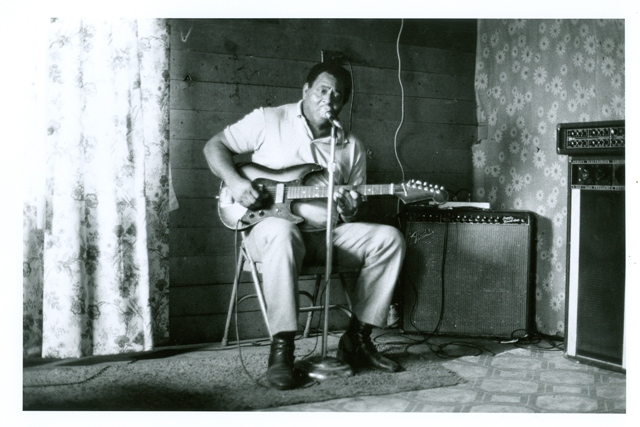
“Meet Me In The City” is a tune that falls under the category of “North Mississippi hill country blues”. What characterizes hill country blues music is its emphasis on the groove and rhythm. It has a percussive aspect and a strong, droning rhythm which gives it a sort of haunting quality. Go listen to the Mississippi delta blues of Robert Johnson or Charley Patton, or even the blues that Muddy Waters brought from the Mississippi Delta to Chicago. Hill country blues is very different music than that style of blues, even though they came out of areas less than a hundred miles apart.
Most hill country bluesmen, to generalize, didn’t really ever leave home for the big cities to become commercial artists. They stayed home with their families, they farmed, they played at cookouts, juke joints and house parties. They didn’t have massive hits and drive Cadillacs. It’s a different kind of lifestyle that produced a different kind of sound. They were singing about the same things, but hill country blues is down home. It’s earthy. It’s raw in emotion.
Listen to R.L. Burnside. T-Model Ford. Asie Payton. Mississippi Fred McDowell (a big inspiration to Junior Kimbrough). If you listen to John Lee Hooker
(who was from North Mississippi but closer to the delta) you can hear the influence of North Mississippi hill country blues in his playing. That repetitive, droning sound.
In terms of music theory (not to go too deep because I know a lot of us are scared of theory – also I think theorizing certain music does it a disservice), Hillcountryharmonica.com hits it right on the head, saying “Hill country blues often sticks to the I chord rather than making a change to the IV or the V. Sometimes, though, hill country blues spends most of its time on the IV chord, like a dancer who always starts off on his left leg but quickly hops to his right, and holds the pose. This harmonic shift, when it shows up, gives hill country blues a haunting, uncanny sound–what musicians call a “suspended” sound. I might kill you right now, baby, but then again I might just sit here all night long and never do it. That sort of sound.”
Very well put.
In the 1990s, partially due to the 1991 documentary Deep Blues: A Musical Pilgrimage to the Crossroads made by musicologist and author Robert Palmer, Junior, along with a lot of other hill country bluesmen, were “rediscovered” (I hate that term) by the music industry. Though Junior was recorded briefly in the 60’s and 70’s for a few anthologies, he saw a revival in his career and received well deserved success before he died in 1998.
Growing up, The Black Keys were probably my favorite band – and one of some damn good bands that were inspired by hill country blues during its “revival” in the 90’s. Most recently, they released the album Delta Kream (2021) – which hit #1 on the Billboard Top Rock Albums in the US – and is an album that’s exclusively hill country blues covers written by artists like R.L. Burnside and Junior Kimbrough, as they paid homage to their roots and inspiration.
While The Black Keys covered Junior’s “Do The Rump” on their debut album The Big Come Up (2002), in 2006 they released Chulahoma, a tribute album to Junior that included their own cover version of “Meet Me in The City”.
In the liner notes of Chulahoma, Dan Auerbach (guitarist/vocalist/songwriter/now-producer) reflects on the first time he heard Junior Kimbrough’s music – and you’ll realize his music just has this effect on people.
Dan said “I was 18 years old…I was away at college, in that little Ohio town. There, alone in my room, I was transformed. It was by this man and the music on that CD … Very suddenly, I was skipping class to play guitar. Shortly thereafter, I’d be dropping out of college altogether. Setting out to find my own way. The bar had been set impossibly high and there was nothing more those professors could help me with. I’d found a new teacher.”
“I feel like a man blessed with some sort of mind and heart connection to the vibrations I find in the music I love. The walls came tumbling down and the earth shook when I locked into Junior’s groove. I’ll be forever grateful, forever in awe, and forever indebted to Junior Kimbrough. Someday, I’m gonna meet him in the city and I’ll shake his hand and maybe he’ll play a few songs for me.”
Ain’t that just the way.
There’s a lot of beauty about “Meet Me In The City”, and in blues music in general, because while music is typically seen as a “structured” thing, there’s so much room for improvisation.
In the case of “Meet Me In The City”, there’s three officially released versions of the song by Junior, one that’s two and a half minutes long, one that’s just over three (the one I’ve been talking about here), and one that’s just under seven minutes – each version different from the other. In the case of the seven minute version, first featured on Junior’s LP All Night Long (1995), he ad-libs a ton of lyrics that aren’t on the others. He’s jamming, he’s rapping, he’s doing it all in a blues tune.
As a blues lover and musician, I’ve learned too many music listeners and even musicians will listen to blues and write it off as “boring”, or “not exciting”, or it “sad” – but what it comes down to is this.
Blues music is some of the most intricate music that there is. Listen to Junior Kimbrough and try to play like he does on “Meet Me In The City”- you can’t. There’s so many inflections and nuances that are impossible to imitate in a way that other music is so easily imitated. Nothing sounds like him. And if it’s “boring”, or “isn’t modern enough” – think of it this way:
Without the pedals, without the fancy chord changes, the synth sounds, the carefully composed riffs – you’re hearing music as raw as it can get. And in the case of Junior Kimbrough’s “Meet Me In The City”, that’s just a man and his guitar. That’s as close as you can get to looking into a man’s soul.
Give it a listen.
 All Kindsa Music Mag
Leave a comment